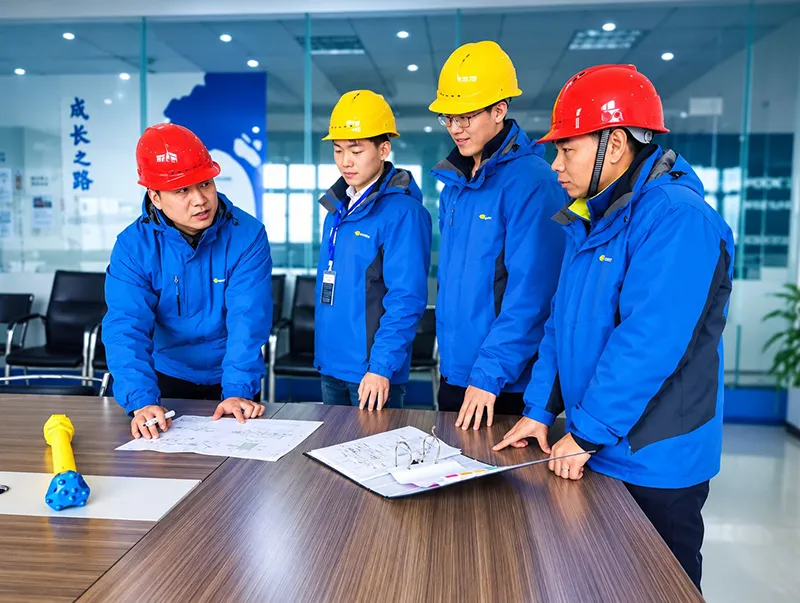
Xinjiang Copper-Gold Mine Underground Pre-Support
Year: 2025
Location: China
Application: Self-drilling pipe roof support system
Services: R51 Self-drilling anchor bolts, Tunneling jumbo, on-site technical support
Project Background
The project is in Ili Prefecture, Xinjiang Uygur Autonomous Region, at an elevation of 2,500–2,600 meters, representing a typical high-altitude mining environment. The underground workings contain abundant groundwater, and up to 40% of the rock formations are prone to collapse, resulting in highly complex geological conditions.
The project plans four mine tunnels, with a total planned excavation length of approximately 17 km, of which the fractured zone accounts for about 6.8 km. Tunnel face dimensions are 4.2 m × 3.7 m, reduced to 4.0 m × 3.6 m after shotcreting. The original construction method used drill rods to insert φ40 small advance pipes, supported by high-density steel arches. This method resulted in frequent supports, slow advance, high costs, and significant safety risks.
Challenges
The original method using φ40 small advance pipes with steel arches faced the following problems:
Poor Safety: Small pipes could not effectively support fractured rock, leading to collapse of pipes and surrounding rock, posing serious safety risks.
Low Advance Efficiency: Daily excavation advance was only 0.8–1.2 m, below production requirements.
High Cost: Comprehensive cost per meter reached 10,000–12,000 CNY.
Construction Difficulty: Boreholes in fractured zones easily collapsed, making pipe insertion difficult or bending the pipe; in extreme cases, drill rods remained stuck in the hole, dramatically increasing costs.
Impractical Equipment: Single-arm drilling rigs on site lacked clamping devices, remote controls, inclinometers, and data interfaces, unsuitable for self-drilling anchor bolts. Turning the rig created blind spots, failing to meet future intelligent mine requirements.
Solution
Material Upgrade: Adopt R51 self-drilling anchor bolts as the advance canopy. Full-length threads allow extension for deeper support. Larger diameter anchors provide greater shear strength. This simplifies procedures, increases anchor utilization, and effectively reduces material waste and overall cost.
Supporting Equipment: Sinorock dedicated self-drilling anchor rig—dual-purpose, capable of installing self-drilling anchors and performing drill rod excavation. Equipped with a single clamping device, maximum drilling depth up to 20 m. Remote control eliminates blind spots during turns, inclinometer allows precise control of protrusion angles. Adaptable to smaller 2 m × 2 m tunnel sections for flexible operation under complex conditions.
Results
The Sinorock team completed four cycles of on-site anchor drilling tests, achieving a total drilling length of 448 m. The advance support depth increased from 4 m to 8 m, blasting depth improved to 1.5–2.5 m, and steel arch spacing increased to 1.5–2.5 m. Calculations show a 30–40% reduction in construction costs and over 40% increase in construction efficiency. The method has now been widely applied to fractured zones in this mine.
Client Feedback
Sinorock provided on-site support, collaborating with local technicians to conduct experiments and analyses. The self-drilling canopy support proved effective, further improving construction efficiency.