In tunneling, pre-support refers to techniques used to stabilize the ground ahead of the tunnel face before main excavation. This is particularly important in weak, fractured, or water-bearing soils to prevent collapses, excessive deformation, and water inflow, ensuring safety and maintaining construction quality.
1. Classification of Tunnel Pre-Support Methods
Based on the mechanism and construction method, tunnel pre-support methods can be classified into four major categories:
1.1 Pipe Roofing and Umbrella Arch
Pipe roofing and umbrella arch methods stabilize the ground by inserting steel pipes along the tunnel crown outside the excavation profile, forming a rigid arch to support the overlying soil. They provide high stiffness and strong load-bearing capacity.
Pipe Roofing / Umbrella Arch: Suitable for tunnel portals, shallow tunnels, or crossing important structures or faulted zones where settlement control is critical.
Pipe Canopy Method: Commonly used for large-section or shallow tunnels, especially under railways or rivers, forming a temporary waterproof enclosure.
Jet-Grouting Pipe Roof: For soft, saturated, and flowable soils; forms a consolidated shell combining strength and waterproofing.
Steel Tube Slab (STS) Pipe Roof: Provides extremely high stiffness for tunnels under critical infrastructure, controlling settlement to minimal levels.
Freeze-Sealing Pipe Roof (FSPR): Combines pipe roof and freezing for shallow, large-section tunnels in high water or soft soils.
1.2 Forepoling and Small Pipes
These methods insert inclined rods or small pipes ahead of the tunnel face to connect the ground with the support structure, providing reinforcement and stability.
Rock Bolts: Suitable for low-stress, fractured rock with low groundwater.
Small Pipe Canopy / Forepoling: Common in shallow tunnels with class IV or higher rock; cost-effective and flexible.
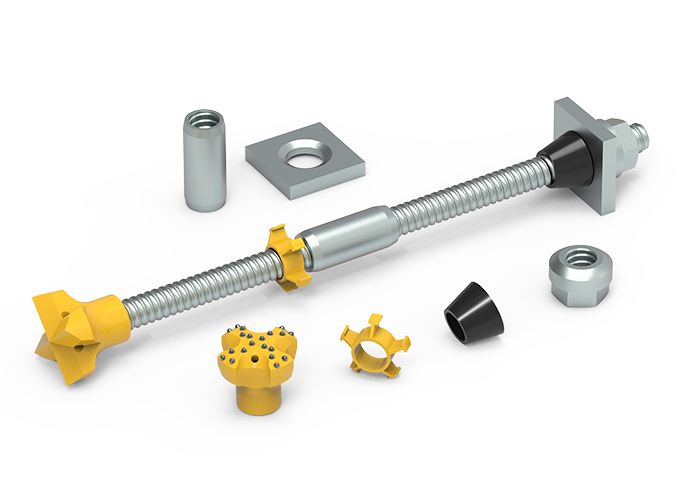
Self-Drilling Anchors: Ideal for broken, loose, or unboreable soils, such as fault zones, gravel, or fill.
Glass Fiber Reinforced Polymer (GFRP) Bolts: Can be cut directly by tunnel boring machines (TBM), used at TBM launch or arrival zones.
1.3 Grouting and Jet Grouting
Grouting techniques inject cementitious or chemical grout into the soil to fill voids, consolidate the ground, and reduce permeability.
Pre-Grouting: Effective in fractured rock, fault zones, and water-bearing sands, enhancing strength and reducing permeability.
Horizontal Jet Grouting: For soft, saturated soils (mud, silt, clay, fine sand), forming continuous reinforced waterproof barriers.
Sleeve Valve Pipe Grouting: Used in non-homogeneous soils, allowing precise control of grout injection with minimal disturbance.
1.4 Ground Freezing
Ground freezing uses artificial refrigeration to turn water in soil into ice, creating a high-strength temporary support and waterproof barrier.
Artificial Ground Freezing (AGF): Suitable for high water pressure, quicksand, and soft saturated soils that are difficult to stabilize by conventional grouting.
Freeze-Sealing Pipe Roof (FSPR): Combines pipe roofing and freezing advantages for shallow, large-section tunnels.
Saltwater and Liquid Nitrogen Freezing: Saltwater freezing for routine construction; liquid nitrogen for rapid or emergency freezing.
In practice, composite methods (e.g., pipe roof + small pipe grouting) are often used to combine the advantages of different techniques for optimal support.
2. Comparison of Tunnel Pre-Support Methods
Selecting an appropriate pre-support method requires balancing geological conditions, environmental requirements, cost, and construction speed.